


There are countless quotes and mystified commentary about Marilyn Monroe’s “childlike innocence.” From Elizabeth Taylor to John Strasberg, all remark on this uncanny quality, as if incongruous with her womanly physique.
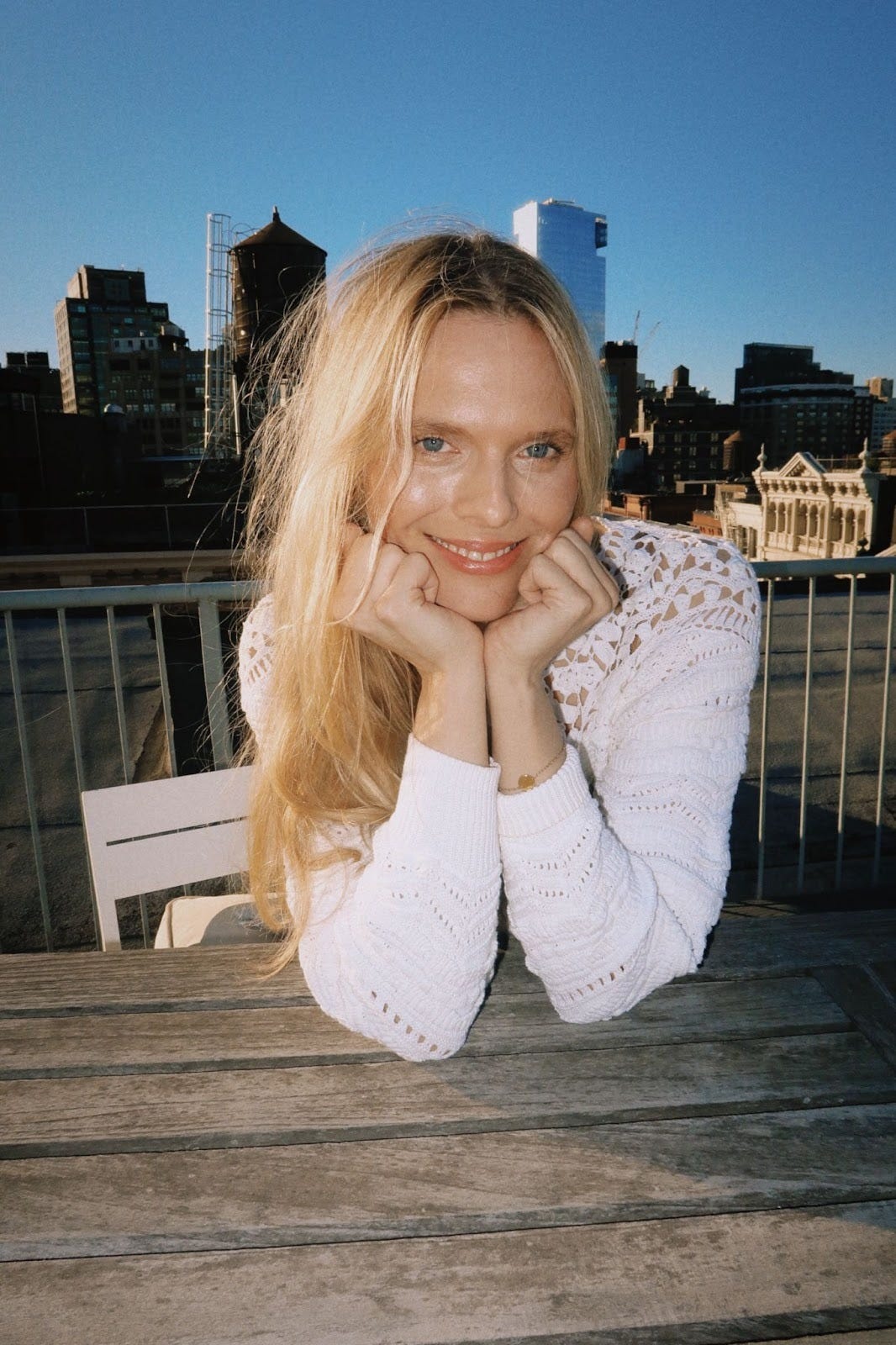
It was the phrase I found myself returning to after meeting Jasmine Lobe. The 5 ‘9 model, actress, former sex columnist and prolific writer (you can read her vast works in The Observer and on Substack), exudes that same ingénue aura in the form of a blonde-haired blue-eyed beauty.
And not unlike Marilyn, Jasmine’s looks have shaped how most of the world sees her — barely noticing (or choosing to ignore) the brains and depth behind them.
She has written about her encounters with men from her days as a working actress in the “wild west” of Hollywood, and spoken publicly about being assaulted by Harvey Weinstein.
She writes about the good men, too, like the man who whisked her away from an afterparty and held her, kissed her under the stars on one of those perfect New York City nights.
Jasmine’s work explores what it’s like to be a woman through reflections on relationships with men. Raw, unfiltered and often sexually charged, I asked her where she got such confidence to be so soul-baring: “Because part of the problem with the patriarchy is that when these dynamics stay hidden in shame or silence, they become insidious; they shape how people relate to each other.”
Her directness and unflinching understanding of why she’s here feel as salient as I imagine Marilyn’s must have been when she broke the trance of her own childlike innocence.
Jasmine is here to share her story — her many stories, from the many lives all women live in a lifetime — and to help rewrite the stories for the women of the future.
Read Jasmine’s story on where she is now, below.
Molly: You’ve written so vulnerably about love — about letting it in, letting it go, and holding the men who’ve abused or mishandled it accountable. How did you get to that place of being brave enough to write about it?
Jasmine: I majored in English, with a focus on creative writing — but shortly after graduation I went to Hollywood to act. I was there for about six years — or, as I like to joke, two, three-year car leases.
Toward the end of that time, I showed a friend of mine, the writer Melanie Berliet something I’d written. It was about Harvey Weinstein. I didn’t name him then — it was more like I just needed to get the experience out of my body. One of the things he said to me was, “Promise me you’ll never write about me.” Which, of course, is the worst thing you can say to a writer — it’s like handing her a pen and setting a timer.
Still, I didn’t write about him for years. Then one day I sat down and it all just poured out.
It was around 2011 or 2012 — before #MeToo — and I couldn’t imagine sharing any of this publicly. It felt too raw, too exposing. Hollywood had boxed me in. I was going out for roles that were all some version of blonde girl, push-up bra. I’d go on dates with producers and feel myself slipping into that role — the blonde on the producer’s arm. Part of me almost wished I could accept it, because society rewards you for that. It seemed easier to just go with it — to stop fighting.
But my soul kept saying, Don’t let them bite you. Don’t become a zombie. Keep your soul.
Molly: That’s exactly what Other Wise is about — brushing up against the tide of what you’re supposed to do. Society says, you’re the blonde on the producer’s arm. But something in you resists it. What was your heart telling you you were meant to do?
Jasmine: Acting was my love — if writing was my backbone, acting was my arms and my voice. I studied with an incredible teacher, Marjorie Ballentine, who brought a kind of raw magic to the work that always reignited me when I doubted myself. But at a certain point, she said, “They just don’t get you. They’re trying to put you in a box.”
And she was right. The auditions dried up. I was determined not to fail. I’d been a competitive figure skater growing up — I had to quit after injuries — and I never forgave myself. Instead of thinking, I made it so far, I thought, I failed because my body gave out. So when things got hard in Hollywood, I told myself, I’m not going to let this be another skating scenario. I was fighting for that fifteen-year-old girl whose world fell apart.
Molly: So it was about survival — but also redemption.
Jasmine: Exactly. I started to feel a deep split between how I was seen and how I felt inside. I’d gone from Vassar — where intellect and voice were celebrated — to Hollywood, which said, Forget all that. You’re a blonde. Play the part.
Eventually, everything started to collapse — my agent dropped me, my neighbor died, another was spying on me — it was like the universe was screaming, You’re not listening.
And then, in the rubble, came an opportunity. Melanie showed my writing to someone at New York Natives magazine, and they loved it. They gave me a column called Starf*cked, about being a New Yorker in Hollywood. I’d never been published before. It was terrifying. But the words started pouring out.
Molly: What did you write about?
Jasmine: Everything I’d lived — the contradictions of being a woman in that world. The shame around beauty, money, youth, power. The transactional undercurrent that no one talks about. I wrote about going on a few dates with a billionaire — almost like a journalist observing the dynamic. He once took me into a store that sold thousand-dollar sheets and bragged, “My Italian designer will be furious that I cheated on her with Frette.” Meanwhile, I was wondering if I could pay rent.
I wasn’t looking for him to save me; I just wanted to feel, for a moment, that everything was okay. But it wasn’t. I recently wrote something along the lines of “proximity to power doesn’t strengthen you — it weakens you.” You can’t tap into someone else’s roots and make them your own. You have to grow your own.
Writing about it — naming what’s usually hidden — was how I took my power back.
Because patriarchy thrives in the dark. These dynamics — around sex, money, shame — are everywhere, but no one talks about them. And when you finally bring them to light, that’s when you get your power back. That’s when you’re free.
Molly: You said something earlier that really struck me — that you were fighting for an identity. I imagine that identity was fractured when you got injured as a figure skater. I relate — I was a soccer player, and those identities can feel inseparable, like I’m Molly, I play soccer.
When that part of you was suddenly gone, how did you cope with that loss? And how did that experience shape the path that led you toward storytelling — through acting, modeling, and now writing?
Jasmine: It was devastating. It wasn’t just one injury — it was chronic. And I was also struggling with an eating disorder. By the time I quit, I was sixteen. One summer my body just stopped recovering. I used to pull my hip flexors and be back on the ice a week later, but this time, the pain never went away. I wasn’t eating enough, I was still growing, my nervous system was out of whack — it was the perfect storm.
And you know, in figure skating, prepubescent bodies are celebrated. I didn’t want boobs. I didn’t want to be sexualized on the ice. I wanted to stay a little girl forever because that’s where the freedom was. Once you’re sexualized, it becomes invasive.
So I kept fighting for it. My dad would take me to the rink, and I’d go through the motions — marking jumps, pretending I’d get better. But I was just holding on. I went to physical therapists, no one could figure it out. Spiritually, emotionally, physically — I was breaking down.
Molly: What led you to acting?
Jasmine: I always loved performing. I was a storyteller, even on the ice — I told stories with my body. There’s nothing like figure skating. Flying across the ice at sunrise, the wind against your face, the sound of the blades, that sense of power — it’s otherworldly. When I lost that, I didn’t know what to do.
Acting became the closest thing. It wasn’t the same, but sometimes, doing a monologue, my heart would expand in that same way: I could still feel. I could still tell stories.
At the time, I was also modeling, but that stopped making me happy (I was in pain from previous hip flexor injuries that would often flare up on shoots). Eventually, I told my agency I’d sprained my foot and just… never called back. Meanwhile, a lot of the girls my age went to Paris and were assaulted by their agents. So in a way, I was being protected.
I remember thinking, I want to go to Paris, I want to have a life, and instead I was in my bedroom icing my groin and studying for the SATs. My world fell apart. I was extremely depressed. But when you fall apart like that, you have to put yourself back together.
Ever since skating, my life has been that process — putting myself back together. Not as the ten-year-old I once was, but as the woman I am now. Understanding my body, my nervous system, my hypervigilance. Strengthening my muscles. Learning to love myself.
Molly: So much of what inspires Other Wise is the idea that we hold multitudes — but we’re often encouraged to show only the acceptable parts. It sounds like you’ve reached a place where you’ve integrated all of it — the skater, the storyteller, the actress, the writer.
When we first connected, you mentioned stepping back from public writing because people were projecting their ideas onto you; people even describing you as “the It girl”. You kept writing privately but stopped sharing. What did that time of retreat teach you? And when did you realize that writing wasn’t just armor — it was your power?
Jasmine: You mean when did I stop resisting it?
Molly: Yeah — when did you just follow it and think, this is what I’m here to do?
Jasmine: Honestly, I still resist it. I’m in constant resistance. There’s a part of me that just wants to be safe — to watch Netflix, to fit in, to not be projected onto. That part says, Why would you share that? Why would you tell people something you’re ashamed of? Why would you hand them your soft spot and say, “Here, shoot right here — I have no armor”?
But that’s what being a writer is. It’s a calling. A soul calling. And once you release the words, the shame loses its power. Yes, people might judge or misunderstand you — and that’s hard — but the sense of purpose, the knowing that this is what I’m meant to do, always outweighs the fear.
Molly: Go deeper with that — what does that feeling of purpose actually feel like for you?
Jasmine: Even during that break from public personal writing, I was at war with myself — part of me wanted to share everything, and another part said, no, not yet. That struggle became its own birthing process, that creative tension before something new arrives. Eventually, you just get tired of wrestling with yourself and surrender. You know who you are, what you’re here to do, and at some point, you just say, fuck it — and leap. But even then, there are always more leaps ahead.
Right now, I’m working on two very sexual stories, and it’s confronting. During my old column days, I often wrote about sex, but sometimes it felt performative — like I was trying to be pretty, pleasing, perfect. My audience was mostly men, which surprised me. I realized I was still performing, still making others comfortable — something women are taught to do.
This time, with my Substack, I want it to be embodied. Integrated. For so much of my life, I disassociated — especially during the #MeToo era. When you’re on TV talking about an assault, you can’t be in your body; you’d fall apart. So you intellectualize it — talk about the pain instead of from it.
Now, I want to write from the body. And when I write about sex, I want people to understand — this isn’t for titillation. It’s about reclaiming my power. I’m not performing; I’m exploring my own sexuality and womanhood through writing.
There’s so much vulnerability in that. Writing about sex is really writing about longing — the human attempt to connect, to reach another person and often miss, but try again anyway. We’re all searching for oneness, and sex and relationships are just microcosms of that search.
Molly: Yes. And I think in today’s world, vulnerability itself is judged — not just sex or love, but the act of being seen. Especially for Gen X and millennials, there’s this tension between being authentic and being exposed.
And you said something earlier that I keep hearing from other people I interview: this moment when they realize, what I’m doing is for no one else but me. It sounds like you’ve reached that place — where you’ve stopped worrying about performing or pandering. You’re doing what lights up your own soul.
Jasmine: Yes. There’s…a purity to that. And if it touches someone else — if it resonates — that’s beautiful.
But it starts with me. It’s like the oxygen mask rule on airplanes: you have to put on your own first before helping anyone else. You have to nourish yourself first.
Molly: It’s true. So many of the creatives I talk to — no matter their medium — end up saying something similar. They find happiness and success when they finally stop trying to please others and just do what makes them come alive.
And it sounds like you’re there.
Jasmine: I don’t know if I’m all the way there. But I’m close.
Molly: I was surprised to learn you have so many male readers because I’d imagine women would be drawn to your voice, the honesty in how you write about love and desire. Did you ever get signals from women that encouraged you to keep going — messages that said, “Yes, this is it. You’re on the right path”?
Jasmine: Yes, definitely. A lot of women — and people in general — reached out, often asking for advice about dating or love. Sometimes I’d think, Have you read my columns? I don’t have it all together! But I also received beautiful messages from readers saying, “Thank you. I feel this way too.”
That, to me, is the power of writing — making someone feel less alone, more seen. When we’re isolated with feelings of shame or sadness, it’s heavy. But connection lightens it. One man recently wrote that my Substack helped him understand his daughter better. That moved me deeply.
Those moments — being told my work touched someone — they still mean so much. I’m not sure it’s about validation so much as recognition. It’s being seen for what you’re doing.
Molly: Yes! It all comes back to connection — having a witness and being one in return.
You have this incredible duality — a fierce, uncompromising voice on the page, and such a grounded tenderness in person. Do you see those as separate parts of yourself, or are they one and the same?
Jasmine: I think my writing voice is sometimes ahead of me — like I’m still catching up to it. There’s a fierceness in the way I write, but a softness underneath. I’ve been exploring that balance more — writing about love in gentler, more expansive ways alongside the darker, more lovesick pieces. We’re all moving between those poles — openness and isolation — trying to find where we feel most ourselves.
Molly: And when you reach that place of comfort or peace, do you find you care less about how others perceive you?
Jasmine: I think so. It’s something I’m always striving for — to be fully myself, whoever that is in each moment.
And I have to say, there was one moment that really crystallized that for me. Before speaking publicly about my experiences with Harvey Weinstein and James Toback, I remember sitting in a back room, terrified. It felt surreal — I’d been on television as an actress, but never like this. Then I took a sip of Coca-Cola — of all things — and suddenly felt this surge of purpose run through me.
It was like, this isn’t just about me. It’s about something bigger — about women, about truth, about change. And that realization grounded me completely. It’s a moment I’ll never forget.
Molly: All I can think, hearing that story, is how moments like that often happen when we’re pushed out of our heads — when something bigger than us moves through. It’s like you’re suddenly a channel for something — call it spirit, intuition, whatever. It’s almost divine.
And your story reminds me of a line I recently heard — I think it was on Jay Shetty’s podcast with Madonna. She said, “You manage the light; you don’t own it.” That’s what you did in that moment. You honored the light, you didn’t try to control it — you just let it move through you.
Jasmine: Exactly. I went from being totally in my head to feeling grounded, embodied, almost zen. Completely focused. Who knew it only took one Coca-cola? (Laughs.)
Molly: I usually end with some version of this question — though I have about a hundred more I could ask you. What would you say to people — and specifically to women, maybe younger women — who are struggling with who they’re told to be versus who they actually are?
JASMINE: I think awareness is key. Even though social media can be toxic, there’s also beauty in it — it allows women to connect and share that awareness. To hear other women say, You don’t have to act this way. You don’t have to fit into that box.
That’s why it’s so important for older, wiser women to reach back and speak to younger ones who might be struggling. To say, “You’re allowed to be complex. You’re allowed to be soft and strong and strange all at once.”
Molly: Who are some of those women for you — the ones you look up to?
JASMINE: Jane Goodall comes to mind first. She has such a kind, generous spirit — her passion and gentleness have guided her through the world, and I really admire that. And Gloria Steinem — what she’s done for women is extraordinary.
Nina Simone, too. She lived a difficult life, but her music holds so much truth. There’s one song, Stars — it’s raw, full of grief and beauty all at once. That duality moves me.
And I’ll say this — politically, it’s such a frightening, uncertain time. But no matter what happens, no one can take away your awareness or your consciousness. Once you’ve seen, you can’t unsee. Once you know, you can’t unknow.
And finally, to young women especially, don’t be afraid to say no. We’re so conditioned to be nice at the cost of ourselves. Always trust your intuition.
Connect with Jasmine here.
Thank you for capturing my essence!!